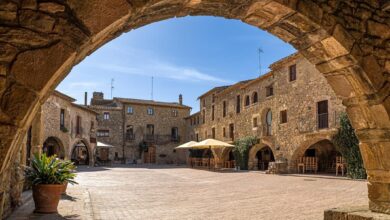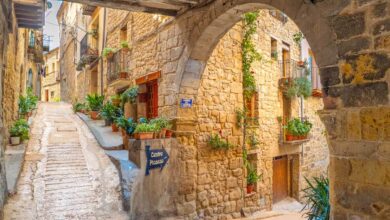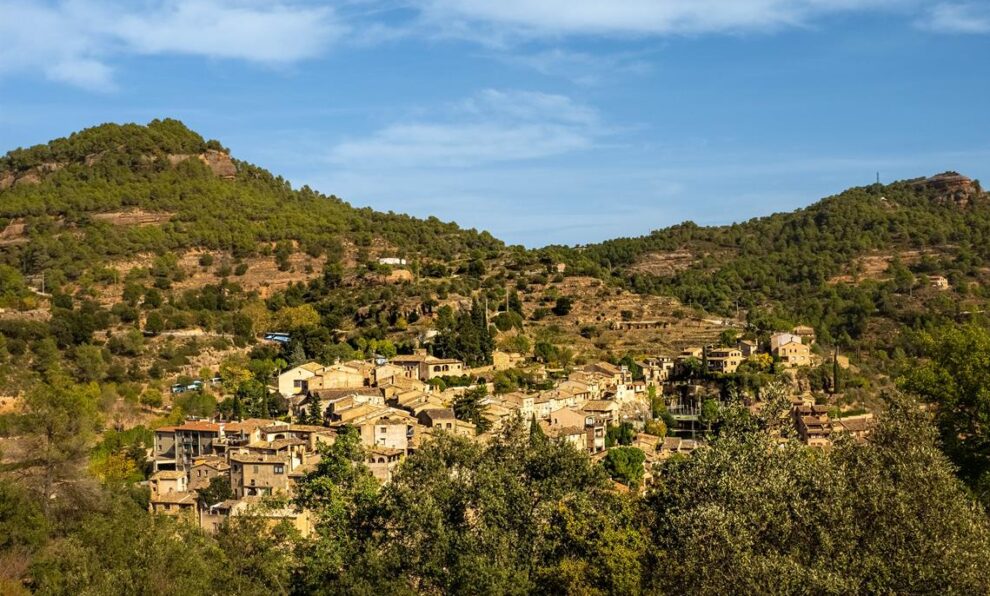
Located 450 meters above sea level in a small valley surrounded by mountains, you’ll find Mura. A charming little village that invites you to wander through its streets and discover its medieval essence.
Mura is a municipality in the Bages region, whose main attraction is the medieval charm of its village combined with its privileged location near the Sant Llorenç del Munt i l’Obac Natural Park.
The village is home to 231 residents, according to 2021 data.
What to See in Mura
Before exploring its streets, you’ll need to park your car in the free parking lots at the entrance, as driving and parking are prohibited within the village. This restriction allows you to stroll peacefully and immerse yourself in the authentic medieval atmosphere.

In the historic center of the village, you’ll find various historic houses related to the area’s ancient trades, such as oil mills and ironworks, like the old oil press or the 18th-century wine vats of Ca l’Arola. As you enter, you’ll also see the cross of Mura, a historical landmark.


At one end of the village stands the Church of Sant Martí, which dates back to the early 11th century, although not as we know it today. Over the years, the church has undergone expansions, with its most notable feature being the tympanum on the entrance door.

Nearby, you’ll find the town hall, from where you can access a viewpoint offering panoramic views of the village and the surrounding natural park.
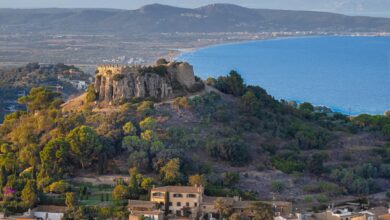
 This small village also once had a castle. The Castle of Mura, first mentioned in 1023, changed hands several times before being abandoned during the feudal era. Today, only the walls and the base of a tower remain.
On the eastern side of the village, as you enter the natural park, you’ll find the Hermitage of Sant Antoni. This Romanesque-style hermitage is dedicated to Saint Anthony of Padua.

Just outside the village, across the bridge over the Nespres stream, lies the Font de l’Era. This area includes a playground, stone tables perfect for picnics, and the fountain featuring a sculpture of a virgin and child. Historically, this was a threshing area for the villagers.

A 10-minute walk along the Estenalles stream will take you to the Font del Rector. Nestled deeper in nature, this spot is perfect for a picnic or a relaxing stop.

A bit further up, you’ll reach the Gorg del Pare waterfall.

It’s impossible to ignore Mura’s stunning location next to the Sant Llorenç del Munt i l’Obac Natural Park. Within the park, you’ll find places like the Puig de la Balma House Museum. This 12th-century farmhouse is a museum showcasing traditional tools and utensils used in the past, and it also offers accommodation for an authentic experience. Additionally, it served as a filming location for the movie *Pa Negre*.
The park also features the famous Mura Caves, discovered by a farmer in the late 19th century. Over the years, excavations and adaptations have made the caves accessible for guided tours, where you can learn about their geological value, as well as the flora and fauna. Guided visits are mandatory.
Finally, about a 30-minute drive uphill, you’ll reach the village of Talamanca. This similar village offers a landscape that complements Mura’s essence, making it a great addition to your visit.

What to Do in Mura
Thanks to its location near the natural park, Mura offers a wide range of activities to enjoy and immerse yourself in nature.
The most popular activity is hiking. You’ll find a great variety of trails to explore. The most recommended ones are the “Thousand Springs Route” (2.77 km), the “Nespres Stream Route” (5.4 km), and the “Balms, Farmhouses, and Mills Route” (5 km).

Following the Nespres stream, you’ll reach the Font de l’Era and, further ahead, the Gorg del Pare waterfall.
If you want to delve deeper into the natural park, you can try the “Coll d’Estenalles to Mura Route”, which is about 8.2 km long.
Gastronomy
To delight your palate with the best local products, Mura offers excellent meat, chickpeas, olive oil, and wine.
The Bages region is known for its olive trees and some of the finest olive oils in the province, and among the best in Catalonia. Specialized olive oil tastings can be found throughout the area. Additionally, the region has a strong winemaking tradition, producing excellent wines with a designated origin.

Chickpeas are also a local specialty, and you’ll likely find them accompanying many dishes. Moreover, locally sourced meat is another must-try when visiting the area.
Where to Eat
If you want to enjoy a memorable culinary experience, you’ll have to choose from the four restaurants in the village. Each one offers a unique rustic ambiance and a culinary variety featuring local specialties. Additionally, there are picnic areas nearby where you can enjoy the natural surroundings.
Discover more restaurants in Mura on Guiacat.
Where to Stay
In Mura, you’ll find a wide variety of accommodations, ranging from hostels to rural houses and apartments. All of them boast unique rural charm.
Find all rural accommodations in Mura on Guiacat.
Festivals and Local Fairs
Each region, municipality, and village has its own fairs and popular festivities. Here’s a selection to help you make the most of your stay.
On the Sunday closest to April 25, Mura celebrates the Feast of Sant Marc. This tradition originated as protection against lightning and storms. Villagers used to keep a “Sant Marc panellet” (a small cake) to protect them throughout the year, eating it before a prayer on this feast day. Today, the same day also hosts the Mura Artisans’ Fair.
The following weekend, the Mura Hiking Club organizes a pilgrimage from Mura to Montserrat. This pilgrimage, dating back to the 1500s, is a tribute to the tradition of visiting the Virgin of Montserrat.
From April to July, the “Viu el Parc” Program takes place. This program, centered on the Sant Llorenç del Munt i l’Obac Natural Park, offers various activities to explore and discover the park during this season.
During summer, the village hosts Cinema in the Streets, a series of film screenings for all audiences held in different village squares.
In early September, the “Cigronet Threshing Festival” is held. This event is organized to remember the agricultural tasks of the past, with the chickpea—highly valued in Catalan cuisine—as the centerpiece. During these days, tastings are offered, and local restaurants prepare specialized dishes.
During the Christmas season, the “Tió Festival” is celebrated. The entire village is filled with decorative logs (*tions*) performing different roles, and there’s a voting urn to select the Tió of the Year.
Additionally, the village holds several traditional gatherings throughout the year: the Gathering of Sant Antoni (June 13), the Gathering of Santa Margarida (July 20), and the Gathering of Sant Lleïr (late August). On the Saturday closest to each saint’s day, a mass is held, followed by a picnic for attendees.
Best Time to Visit the Village
This village offers several unique and special moments throughout the year, making it hard to choose just one season to visit. On one hand, September is ideal because it’s no longer high season, yet the good weather lingers, making it perfect for exploring the narrow streets. On the other hand, during the Christmas season, the streets are filled with festive tions, creating a magical holiday atmosphere.
Must-Do Activities
After learning more about this charming village, here’s a list of must-do activities:
- Stroll through the streets
- Climb to the town hall viewpoint
- Participate in an activity from the “Viu el parc” program
- Go on a hike in the surrounding areas
What to See Nearby
If you want to discover what lies around Mura to enhance your experience and explore its surroundings, there are several fascinating options just a short distance away. About 15 km away, you’ll find the picturesque village of Talamanca, surrounded by the stunning mountains of the Talamanca range.

Additionally, if you enjoy nature, near Mura is the Sant Llorenç del Munt i l’Obac Natural Park. This park features an impressive landscape of mountains, caves, and Mediterranean forests, making it perfect for hiking, climbing, and observing native flora and fauna.
How to Get There
If traveling by car, head toward Manresa if you’re coming from Tarragona or Lleida, and from there take the BV-1225 road to Mura. From Barcelona, drive toward Terrassa and take the BV-1223 road, which leads directly to the village. Finally, from Girona, follow the C-25 road and, after passing Vall de la Gavarresa, join the B-431 road to connect with the B-124 toward Mura.
If traveling by bus, the closest station is in Manresa, with direct connections from Barcelona (1 hour), Girona (2 hours), and Lleida (2 hours). Additionally, between Girona and Lleida, the L-28 line stops in Manresa. From Tarragona, there is no direct line. Once in Manresa, take the 786 line, which goes directly to Mura.
By train, the nearest station is in Manresa. From Barcelona, take the Rodalies R4 train, which takes approximately 1.5 hours. From Girona and Tarragona, it’s best to take a regional train to Barcelona and transfer there. From Lleida, a regional train goes directly to Manresa in about 2 hours.
If traveling by plane, the nearest airports are Barcelona Airport (1 hour), Girona Airport (1-2 hours), or Alguaire Airport (1-2 hours).